
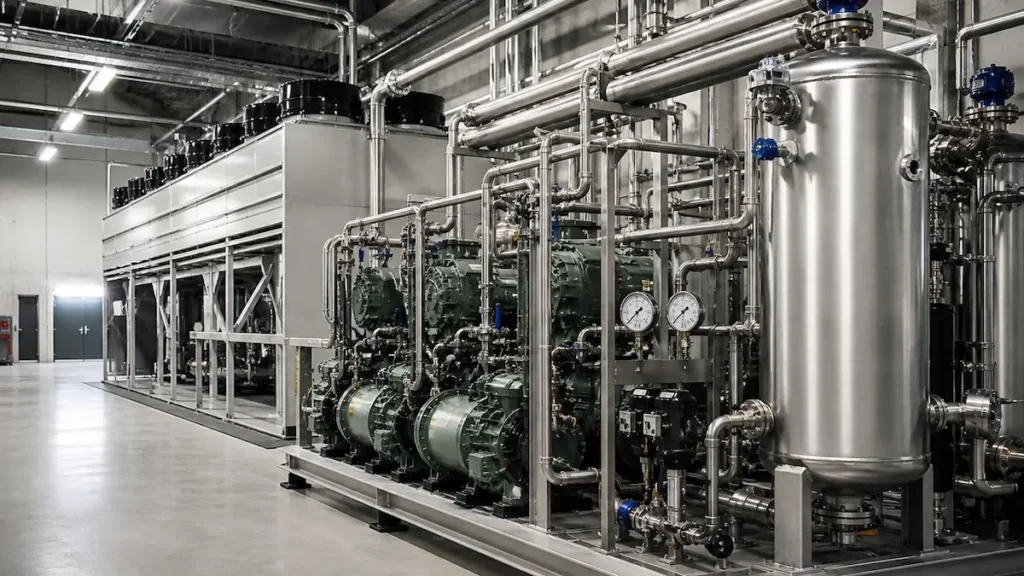
CO2 (R-744) is re-emerging as a commercial and industrial refrigerant after decades dominated by synthetic HFCs. Australia’s HFC phase-down, targeting 85% reduction by 2036 under the Kigali Amendment, is accelerating CO2 adoption in supermarkets, cold storage, and food processing. The key engineering challenge is pressure. CO2 refrigeration systems operate at several times the pressure of conventional refrigerants, and that single factor shapes every design decision from components to safety. This guide explains what CO2 refrigeration is, how it works, the difference between transcritical and subcritical configurations, and what operators need to know about the pressure demands.
What Is CO2 as a Refrigerant?
Is CO2 a refrigerant? Yes. Under ASHRAE refrigerant naming conventions, carbon dioxide is designated R-744. As a CO2 refrigerant gas it carries a Global Warming Potential of 1, zero ozone depletion potential, and an A1 safety classification under AS/NZS 1677 (non-toxic, non-flammable). These CO2 refrigerant properties stand in contrast to the synthetic HFCs it often replaces. R-404A, a common supermarket refrigerant, has a GWP of 3,922. R-134a sits at 1,430. CO2 is orders of magnitude lower.
Using CO2 as a refrigerant is not new. It was one of the earliest commercial refrigerants, widely used from the 1860s through the 1930s before synthetic CFCs and HFCs displaced it. Tightening environmental regulation has reversed that trend. Australia’s HFC import phase-down began in 2018, with quotas stepping down progressively over the next decade. Businesses planning new refrigeration installations need to weigh whether HFC equipment will remain serviceable across its typical 15 to 20 year lifespan.
The defining characteristic of CO2 as a refrigerant is thermodynamic. Carbon dioxide has a low critical temperature of 31.0C, which means systems often operate in transcritical mode rather than conventional subcritical mode. Operating pressures are significantly higher than any HFC equivalent, and that reality drives the rest of the system design.
How a CO2 Refrigeration System Works
So how does CO2 refrigeration work? At its foundation, the CO2 refrigeration cycle (also described as the CO2 refrigerant cycle) is the same vapour compression cycle used in any conventional system: compression, heat rejection, expansion, and evaporation. The twist sits in the heat rejection stage, and it changes behaviour depending on ambient conditions.
In subcritical mode, when ambient temperatures sit below roughly 25C, heat rejection happens in a condenser where CO2 condenses from vapour to liquid, much like a conventional system. In transcritical mode, when ambients climb above 25 to 28C, heat rejection happens in a gas cooler instead. The CO2 stays above its critical pressure and never condenses. It simply cools as a dense supercritical fluid. This gas cooler versus condenser distinction is the single most important concept in CO2 refrigeration. It is also the reason the operating envelope shifts with weather.
At component level, a transcritical CO2 system typically includes:
A CO2 refrigerant compressor (sometimes called a CO2 refrigeration compressor) rated for high pressures up to 120 bar. Standard HFC compressors (typically rated for around 18 bar condensing on R-404A) are not interchangeable. Purpose-built CO2 compressors are required.
A gas cooler or condenser that rejects heat to ambient air or water.
A high-pressure expansion valve that drops pressure from the gas cooler outlet (75 to 120 bar) down to the receiver (around 38 bar).
An evaporator where CO2 absorbs heat from the refrigerated space at low pressure.
CO2’s volumetric refrigerating capacity is six to eight times higher than R-134a. In practice that allows smaller pipe diameters and more compact components, which partly offsets the weight and cost of the higher-rated pressure equipment.
Transcritical and Subcritical CO2 Systems
The critical point, at 31.0C and 73.8 bar, determines which configuration is appropriate. Two approaches dominate: subcritical cascade systems and transcritical CO2 refrigeration systems.
Subcritical CO2 refrigeration keeps both high and low pressure sides below the critical point. CO2 condenses normally in a condenser. In practice, subcritical CO2 is almost always used in cascade configuration, where CO2 handles the low-temperature duty (roughly -35C to -10C) and a second refrigerant (ammonia, an HFC, or a glycol loop) handles medium temperature and rejects heat to ambient. Because the high-side refrigerant manages heat rejection rather than CO2, cascade systems work well across all climate zones, including hot and humid regions.
The transcritical CO2 refrigeration cycle takes a different approach. The high-pressure side operates above the critical point, with gauge pressures of 75 to 120 bar, and a gas cooler replaces the condenser because no phase change occurs. Transcritical booster systems (a single refrigerant loop serving combined medium and low temperature duty) are now the most common commercial configuration in supermarkets. They achieve their best efficiency in cooler climates. Above around 25 to 28C ambient, efficiency enhancements such as adiabatic gas cooling, parallel compression, or ejectors become worthwhile to keep energy use in check.
In the Australian context, transcritical booster systems are widely adopted through the southern states (VIC, TAS, SA). Cascade systems are often preferred in northern QLD and tropical regions where ambient temperatures regularly exceed 30C. Since 2005, more than 30 Australian commercial refrigeration and food processing facilities have installed CO2 cascade systems.
Understanding CO2 Refrigeration Pressures
CO2 refrigeration pressures are the defining engineering consideration for any industrial CO2 refrigeration system. CO2 operates at far higher pressures than any conventional refrigerant, and the numbers shape everything from component specification to charging procedure.
Typical operating pressure ranges in a commercial CO2 refrigeration system:
Low-temperature evaporator: around 13 bar at -32C.
Medium-temperature evaporator: around 28 bar at -10C.
Receiver or flash tank: around 38 bar.
Transcritical high-pressure side: 75 to 120 bar depending on ambient conditions.
By comparison, R-404A condensing pressure sits at 14 to 18 bar. CO2 high-side pressures can be five to eight times higher than the HFC equivalent.
Two thermodynamic points matter more than any others.
The critical point (31.0C / 73.8 bar). When ambient temperature pushes above roughly 25C, the system transitions to transcritical mode and high-side pressure climbs above 73.8 bar. Gas cooler exit temperature becomes the controlling variable: it sets where the optimal high-side pressure lands for maximum COP, and modern transcritical controllers adjust the high-pressure valve to track it.
The triple point (5.2 bar / -56.6C). This matters most when charging CO2 refrigeration systems. If pressure drops below the triple point, liquid CO2 can solidify into dry ice, blocking service lines and damaging equipment. Technicians charging a CO2 refrigeration system must introduce vapour (not liquid) until the system is safely above triple point pressure.
A further hazard sits between these points. Liquid CO2 trapped between two closed valves can generate roughly 10 bar per 1C rise in temperature (CO2 has a high coefficient of thermal expansion). Without relief, this can rupture piping. Pressure relief devices are mandatory on any section where liquid CO2 can be isolated.
All piping, fittings, valves, and pressure vessels must be rated for these CO2 refrigeration system pressures. Standard HFC-rated components are not suitable. Specify CO2-rated components throughout.
CO2 vs Ammonia in Industrial Refrigeration
CO2 and ammonia are the two main natural refrigerant options for industrial-scale cooling, and the choice between them (or how to combine them) is a common decision point for facility planners. The CO2 vs ammonia refrigeration debate comes down to safety versus efficiency, with climate and application shaping the answer.
Ammonia (R-717) has excellent thermodynamic efficiency and decades of industrial track record. It is, however, toxic and mildly flammable, carrying a B2L safety classification. An ammonia plant requires a dedicated plant room, emergency ventilation, gas detection, and extensive safety systems. Regulations also restrict ammonia in occupied spaces, which rules it out for direct use on a supermarket sales floor. Operating pressures are modest at roughly 12 to 15 bar condensing.
CO2 (R-744) is non-toxic and non-flammable, with an A1 safety classification. Compliance is simpler and CO2 can serve occupied spaces directly. The trade-offs are high operating pressure and, for transcritical configurations, efficiency loss in hot ambient conditions.
For large industrial duty, the two refrigerants are often combined. A CO2/ammonia cascade puts ammonia on the high-temperature side (efficient heat rejection to ambient) and CO2 on the low-temperature side (safe for occupied spaces). The ammonia vs CO2 refrigeration question often ends in a cascade that captures the strengths of both.
Decision factors include safety and compliance requirements, climate zone, application temperature range, proximity to occupied spaces, and local regulations.
Advantages and Limitations of CO2 Refrigeration
Weighing CO2 refrigerant advantages and disadvantages comes down to environmental credentials and safety on one side, against pressure demands and capital cost on the other.
Advantages:
A GWP of 1 future-proofs installations against the HFC phase-down and carbon accounting obligations.
The A1 safety classification (non-toxic, non-flammable) means fewer regulatory barriers than ammonia.
High volumetric capacity and strong heat transfer allow smaller pipes and more compact components.
Heat reclaim is practical in transcritical systems. Reject heat from the gas cooler can be recovered for hot water or space heating, lifting overall energy efficiency meaningfully.
CO2 is widely available and inexpensive as a refrigerant, sourced as a by-product of industrial processes.
No special refrigerant licensing is required beyond standard HVAC&R qualifications.
Limitations:
High operating pressures require purpose-built, higher-rated components. HFC equipment cannot be reused.
Upfront capital cost runs roughly 20% above a comparable HFC system. That gap is narrowing as adoption scales.
Transcritical efficiency drops in hot ambient conditions above 25 to 28C unless enhancements such as adiabatic gas cooling or parallel compression are fitted.
Technicians need specific training in CO2 pressures, charging procedures, and safety protocols.
Transcritical booster configurations carry more components and control points than a typical HFC system, which increases commissioning and control complexity.
Taken together, these trade-offs are what facility planners evaluate when deciding whether CO2 is a good refrigerant for their application.
Where CO2 Refrigeration Is Used
Supermarket refrigeration is the largest adoption segment globally, and Australia is following the trend. Transcritical booster systems deliver combined medium and low-temperature duty from a single refrigerant loop, and major Australian retailers are increasingly specifying CO2 for new builds.
Cold storage and distribution facilities for frozen and chilled logistics commonly use CO2/ammonia cascade systems. Food and beverage processing sites (breweries, dairies, meat processing plants) are another strong fit, particularly where CO2 is already present for carbonation or inerting.
Ice rinks and snow-making facilities also use CO2 refrigeration, as do emerging applications such as CO2 heat pumps for hot water, mobile transport refrigeration, and air conditioning (the CO2 refrigerant air conditioner market is growing, particularly in Asia).
For Australian facility planners, CO2 refrigeration is increasingly relevant across food and hospitality applications, manufacturing applications, and agricultural operations using controlled atmosphere storage.
Frequently Asked Questions
What is CO2 refrigerant called?
CO2 is designated R-744 under ASHRAE refrigerant naming conventions. Under AS/NZS 1677 it carries an A1 classification (non-toxic, non-flammable). It is commonly referred to as carbon dioxide, and systems operating above the critical point are described as transcritical CO2.
How does a CO2 refrigeration system work?
A CO2 refrigeration system runs the standard vapour compression cycle: compression, heat rejection, expansion, evaporation. Below about 25C ambient it works subcritically, condensing CO2 in a condenser. Above 25 to 28C ambient it shifts to transcritical mode, rejecting heat through a gas cooler without condensation.
What pressures do CO2 refrigeration systems operate at?
Low-temperature evaporators run at around 13 bar, medium-temperature evaporators at 28 bar, and receivers around 38 bar. Transcritical high-side pressures range from 75 to 120 bar depending on ambient conditions. These are five to eight times higher than typical R-404A condensing pressures.
Is CO2 better than ammonia for refrigeration?
Neither is universally better. CO2 is safer (A1 vs ammonia’s B2L) and suitable for occupied spaces. Ammonia is more thermodynamically efficient. In large industrial settings a CO2/ammonia cascade combines both: efficient ammonia heat rejection at the top, safe CO2 duty at the cold end.
Can CO2 be used as a refrigerant?
Yes, widely. CO2 is used as a refrigerant across supermarkets, cold storage, food processing, and industrial applications. In Australia, CO2 refrigeration is the fastest-growing natural refrigerant category as HFC quotas tighten under the Kigali Amendment phase-down.
Is CO2 a good refrigerant?
CO2 is a good refrigerant for most commercial and industrial cooling. It pairs a GWP of 1 with A1 safety and excellent heat transfer. The trade-offs are high operating pressures and efficiency loss in hot ambient conditions for transcritical systems.
Why are CO2 refrigeration systems becoming more common?
The HFC phase-down is the primary driver. A GWP of 1, A1 safety classification, meaningful heat reclaim potential, and growing component availability all push the economics in CO2’s favour as HFC quotas tighten and carbon accounting requirements grow.
CO2 Supply for Refrigeration and Industrial Applications
Pacific Gas supplies carbon dioxide in cylinders through a network of local distributors across Australia. Food-grade and industrial-grade CO2 are available via the cylinder exchange model, along with N2/CO2 gas mix blends for applications such as beverage packaging and modified atmosphere packaging.
Businesses using CO2 for refrigeration top-ups, beverage carbonation, food processing, or inerting can arrange ongoing supply through their local distributor.
For CO2 supply enquiries, find a distributor in your area or contact Pacific Gas to talk through options. Pacific Gas does not provide refrigeration system design, installation, or consulting services.


