
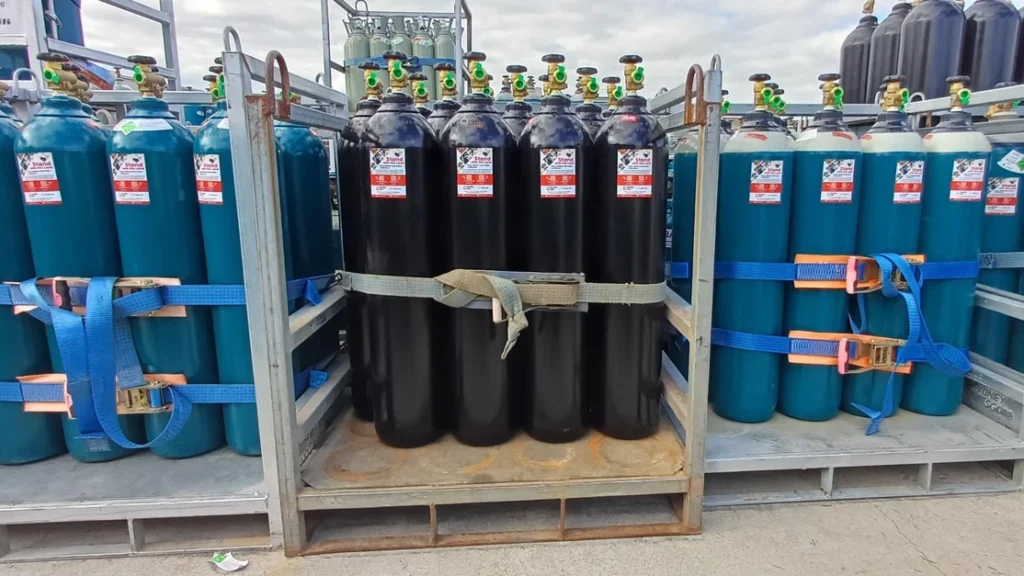
Gas Cylinder Storage Requirements in Australia
Most workshops, factories, venues and rural stores hold at least a few gas cylinders, and the storage requirements that apply to a fabrication shop with twenty bottles also apply, scaled down, to a shed with two. In Australia those requirements come from work health and safety law and the Australian Standard for gas cylinder storage, and they exist for good reason: a cylinder stores a large amount of energy in a small steel package, and stored badly it can fall, leak, feed a fire or quietly displace the air in an enclosed room. This guide covers the practical requirements that apply to storing gas cylinders at Australian workplaces.
The Rules That Apply
Two layers of rules govern cylinder storage. The first is work health and safety legislation: the WHS Act and Regulations (and their state equivalents) treat stored gases as hazardous chemicals and set duties for managing them, including placarding once quantities pass set thresholds. The second is AS 4332-2004, The storage and handling of gases in cylinders, the Australian Standard that regulators and insurers treat as the benchmark for how a compliant gas store is set up.
Requirements vary with the type of gas, based on its dangerous goods classification. Flammable gases such as acetylene are Class 2.1. Non-flammable, non-toxic gases such as argon, nitrogen and carbon dioxide are Class 2.2. Oxygen is also Class 2.2 but carries an oxidising subsidiary risk, which is why it has its own segregation rules. State and territory regulators publish guidance on how the rules apply locally, and this article is general guidance rather than a substitute for it.
Where Cylinders Can Be Stored
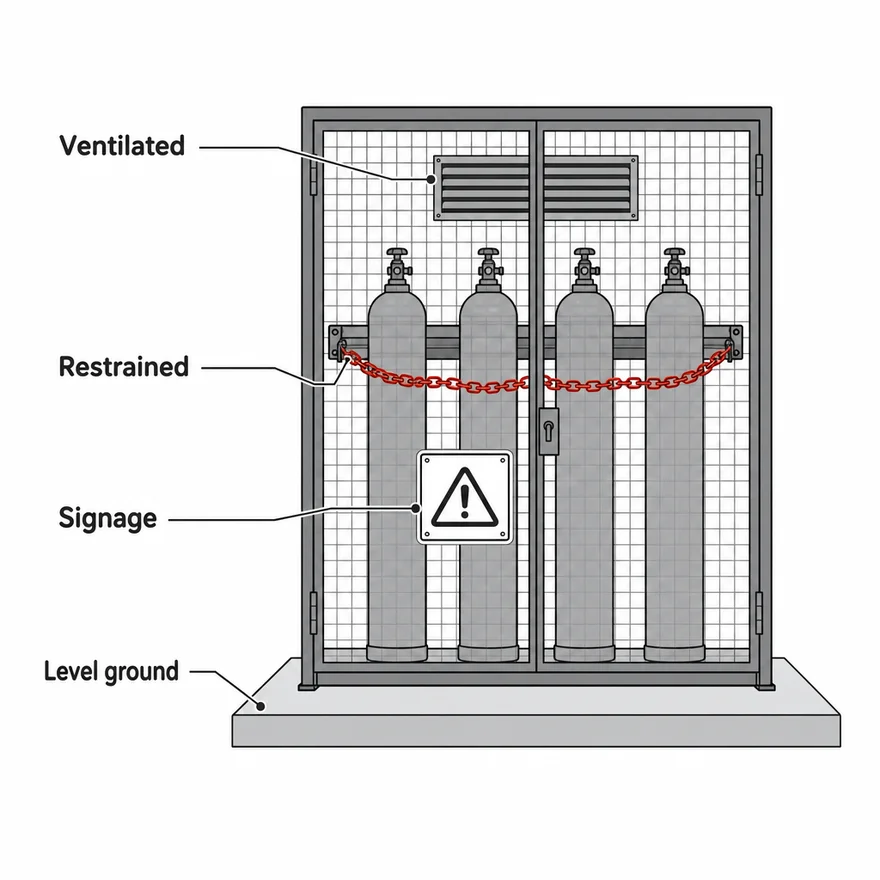
The default answer is outdoors, or in a well-ventilated area, on a firm and level surface. Ventilation is the core requirement: any leak must be able to disperse rather than accumulate. That rules out below-ground spaces, pits and basements, where gases heavier than air, such as carbon dioxide and argon, can pool unseen and displace breathable air.
Cylinders must be kept away from heat sources and ignition sources, and clear of building exits, stairwells and walkways, so a leaking or burning cylinder never stands between people and the way out. Storage areas should be secure against tampering and knocks, which in practice usually means a lockable cylinder cage or compound, with the safety signage the classification requires.
A few things should never share the space. Keep the store clear of combustible material such as timber, cardboard and fuel, and keep vehicle movements away from the cylinders or protected by bollards or barriers. In heavy-vehicle and mining maintenance workshops, where plant moves through the yard all day, that physical protection matters as much as distance.
Upright, Restrained and Capped
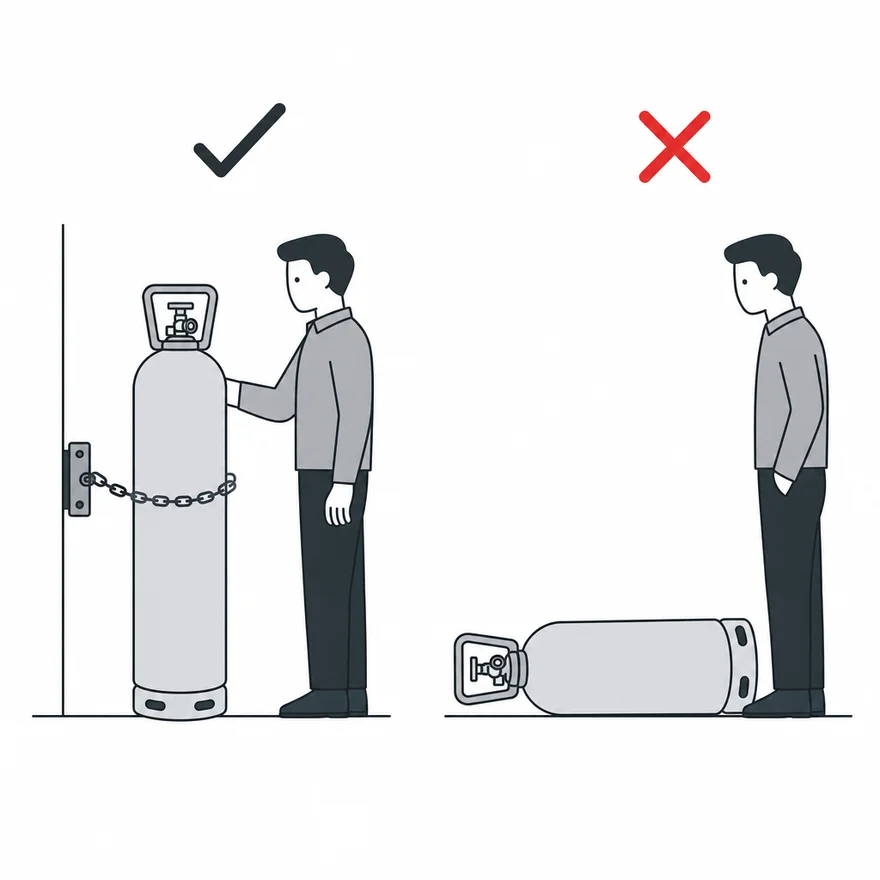
Cylinders are stored standing upright, and restrained so they cannot fall, typically by chain or strap to a wall bracket or inside a purpose-built cage. A falling cylinder can shear its valve, and a cylinder with a sheared valve becomes an unguided projectile driven by its own contents.
Upright storage matters most for acetylene. Acetylene cylinders contain a liquid solvent that stabilises the gas, and storing or using them on their side can draw solvent into the valve and regulator. If an acetylene cylinder has been lying down, stand it upright and let it settle before use.
Valves are closed whenever a cylinder is not in use, including empty cylinders, and valve protection caps or guards stay fitted whenever regulators are disconnected.
Segregating Incompatible Gases
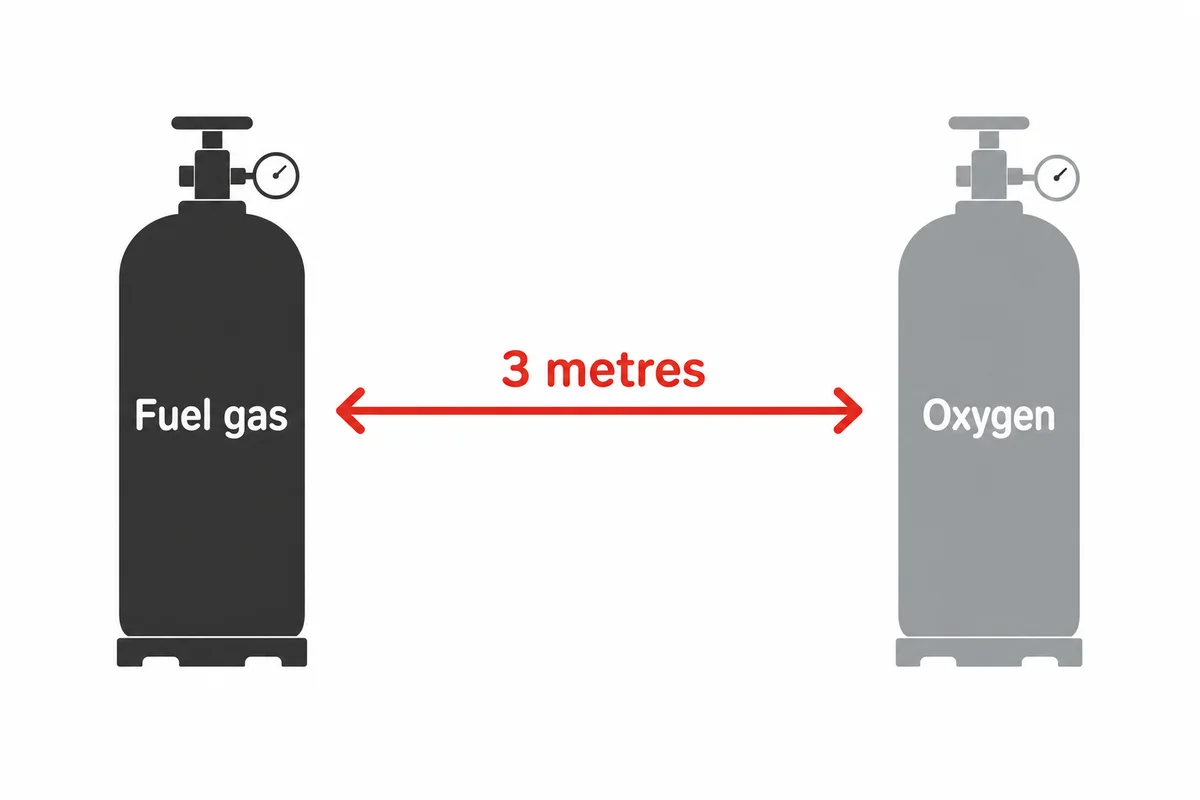
The most important separation rule in AS 4332-2004 is between fuel and oxidiser: flammable gas cylinders (Class 2.1) must be kept at least 3 metres from oxygen and other oxidising gases, or separated by a suitable fire-resistant barrier where that distance is not achievable. In an oxy-acetylene workshop this is the rule that decides the layout of the gas store.
Full and empty cylinders should also be stored separately and labelled accordingly. Empty cylinders are never treated as harmless; they still contain gas at pressure and are handled and restrained the same way as full ones.
Placarding and Quantity Thresholds
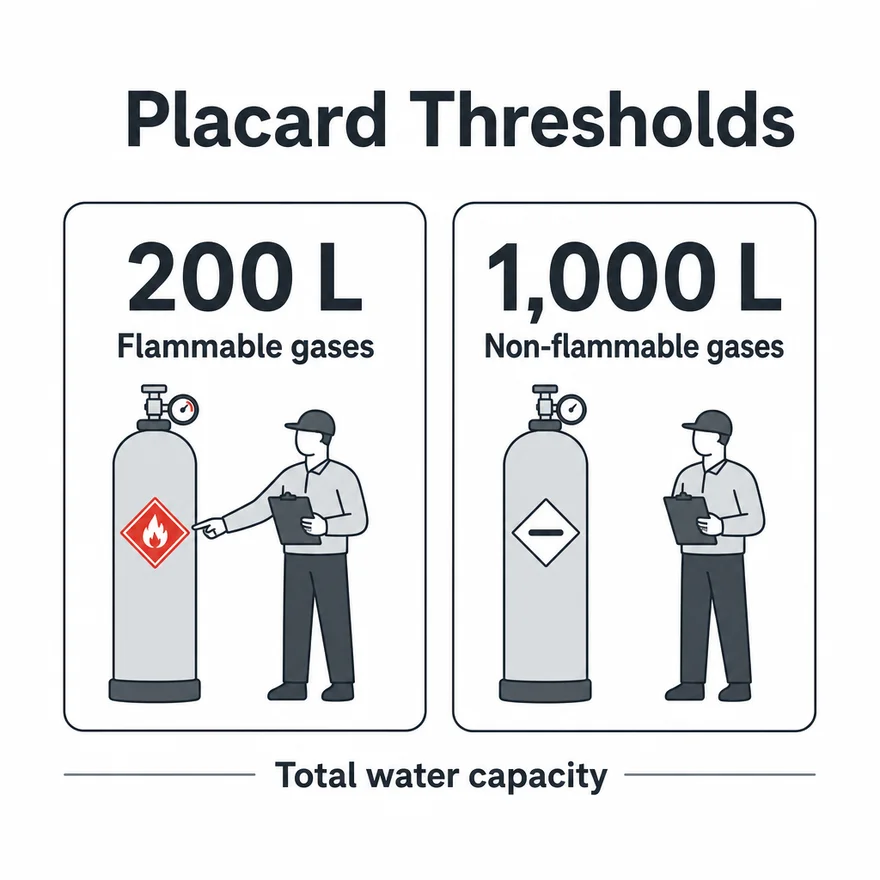
Once a workplace holds more than a threshold quantity of gas, WHS regulations require placards: standardised warning signs at the storage area and site entrance so emergency services know what is inside. The thresholds are set in Schedule 11 of the WHS Regulations and are measured by the total water capacity of the cylinders held, not by how full they are.
For flammable gases the placarding threshold is 200 litres of aggregate water capacity, which a handful of large cylinders can reach. For non-flammable, non-toxic gases the threshold is 1,000 litres. Larger holdings again trigger manifest and notification requirements. Any site holding more than a few cylinders should tally its water capacity against Schedule 11, because the thresholds arrive sooner than most operators expect.
Day-to-Day Handling and Checks
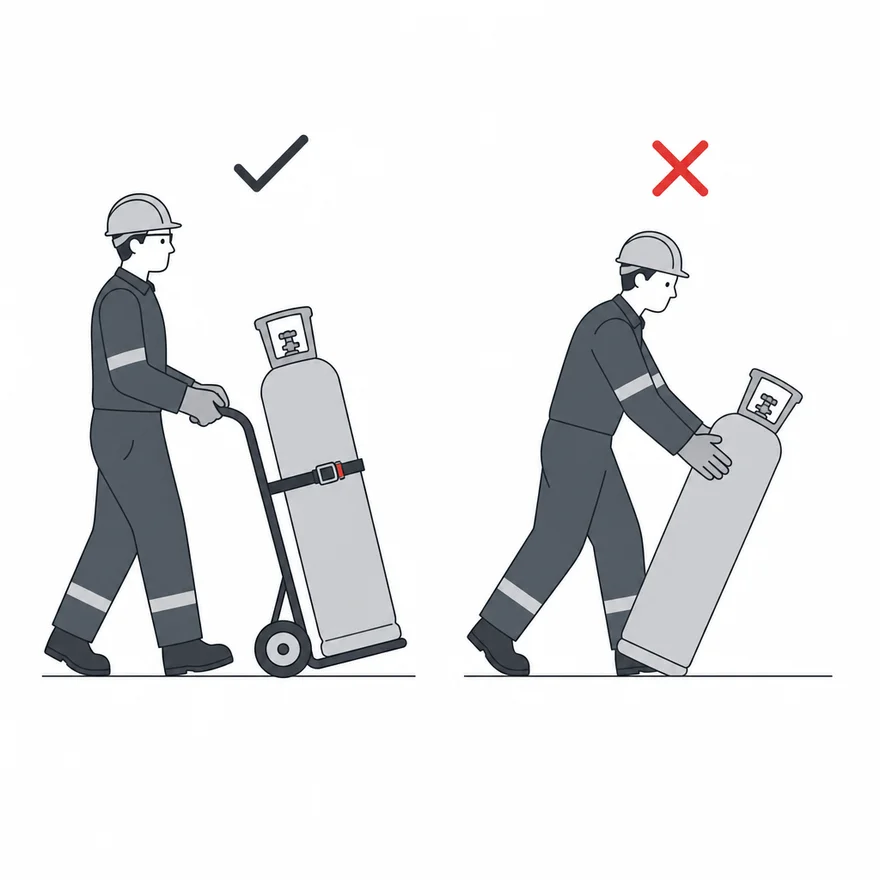
Good storage is undone quickly by rough handling. Move cylinders on a trolley designed for them, never by rolling, dragging or lifting by the valve. Check for leaks with soapy water at the valve and regulator connections, never with a flame. Keep regulators, hoses and fittings in good condition and matched to the gas they serve.
Every cylinder in the store should be in date for its periodic test, with the test date stamped on the neck, and stock should rotate so the oldest cylinders are used first. Anyone who handles the cylinders should be trained in safe handling and in what to do if a cylinder leaks, and the storage area should be inspected routinely so damage, corrosion or missing restraints are caught early.
Gas Cylinder Storage FAQ
Can gas cylinders be stored indoors?
Yes, if the area is well ventilated, away from heat and ignition sources, and the cylinders are upright and restrained. Below-ground rooms, basements and unventilated storerooms are not acceptable, because leaking gas can accumulate and displace breathable air.
Do empty cylinders need the same storage as full ones?
Essentially, yes. Empty cylinders still hold pressurised gas and the same hazards apply, so they are stored upright, restrained and with valves closed. Store them separately from full cylinders and label them so full stock is easy to identify.
How far must oxygen be kept from acetylene in storage?
At least 3 metres, or separated by a suitable fire-resistant barrier, under AS 4332-2004. The rule applies to storage; cylinders connected for use on an oxy-fuel set are covered by their own handling requirements.
Do small workplaces with a few cylinders need placards?
Usually not. Placarding starts at the Schedule 11 thresholds, 200 litres aggregate water capacity for flammable gases and 1,000 litres for non-flammable, non-toxic gases. Below those quantities the general storage requirements still apply, just without mandatory placards.
Compliant Cylinder Supply from Pacific Gas
Pacific Gas supplies industrial gases in D, E and G cylinders through local distributors across Australia, using a cylinder exchange model: an empty cylinder is swapped for a full, in-test one, so periodic cylinder testing is never the customer’s problem to manage. Cylinders are customer-owned, with no rental contract, whatever the volume of use. For help choosing gases and cylinder sizes that keep a site under its storage thresholds, or to get set up nearby, find a distributor or contact Pacific Gas.


