
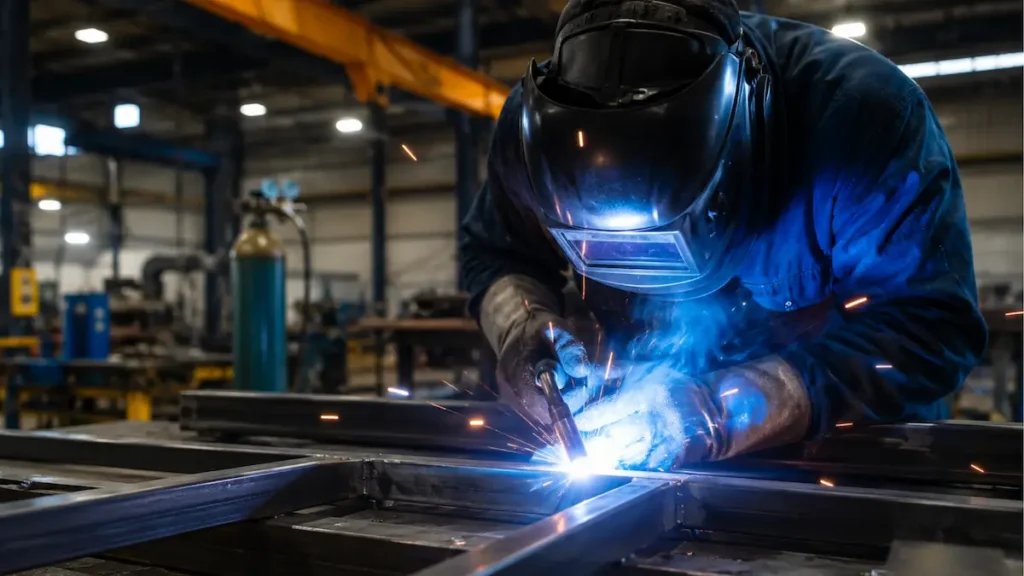
Metal Fabrication Explained: Processes, Equipment and Gas Requirements
Metal fabrication is the broad set of processes that turn raw mill product, plate, sheet, bar, tube, structural section, into finished assemblies. It underpins everything from mining haulage frames and food-processing tanks to architectural cladding and automotive subframes. The work spans cutting, forming and joining, each with its own equipment and, in most cases, its own industrial gas requirements. This guide walks through how metal fabrication is structured in Australian workshops, the main process families operators run, the equipment those processes depend on, and the gases that go through the regulator and into the work.
What Metal Fabrication Covers
Metal fabrication is best understood as a sequence rather than a single process. Raw material is received as plate, sheet, coil, bar or section. It is then cut to size, formed into the required geometry, joined by welding or mechanical fastening, and finally finished by grinding, blasting, painting or coating. A small jobbing shop might run all of this on the same floor; a larger fabricator splits the work between specialised cells.
The choice of process at each stage is driven by material type, thickness, tolerance and volume. Sheet metal under 6 mm is typically laser- or punch-cut and folded on a press brake. Plate from 6 mm to 50 mm goes to plasma or oxy-fuel cutting and a CNC press for forming. Heavy structural section is sawn or thermally cut and assembled by stick or flux-cored arc welding. Stainless and aluminium fabrication runs on its own track because of contamination risk and different welding requirements.
Cutting Processes
Cutting is where most fabrication starts. Each method has a sweet spot in terms of thickness, kerf, speed and material compatibility.
Oxy-Fuel Cutting
Oxy-fuel cutting uses a high-temperature flame to preheat carbon steel to ignition temperature, then a jet of pure oxygen to oxidise the iron and blow the slag clear. It cuts steel from around 3 mm up to 300 mm or more and remains the standard for thick-plate work, mobile fabrication, scrap and demolition. Acetylene is the standard fuel gas for fabrication-shop torch work; LPG and propane are used for production heating, bevel preparation and longer cuts.
Plasma Cutting
Plasma cutting passes a high-temperature ionised gas stream through a nozzle and an electrical arc, melting the work and blowing the molten material clear. It cuts ferrous and non-ferrous metals (stainless, aluminium, copper) at thicknesses up to around 50 mm with cleaner kerfs and faster travel speeds than oxy-fuel on thinner material. Compressed air is the most common plasma gas in workshops; argon, nitrogen and gas mixes are used for higher-end stainless and aluminium work.
Laser Cutting
Laser cutting focuses a high-power laser beam onto the work, vaporising or melting the material with assistance from an assist gas. Fibre lasers dominate new installations in Australian workshops, offering very fast cutting on thinner sheet up to around 25 mm, depending on power. Oxygen is the assist gas for fast carbon-steel cuts; nitrogen at high pressure is used for clean, oxide-free cuts on stainless steel and aluminium.
Mechanical Cutting
Saws (band, cold, circular), shears, punches and turret presses cut without thermal input. They are the standard for short, accurate cuts on bar, section and thin sheet. Mechanical cutting requires no industrial gas, only coolant and lubrication.
Forming Processes
Once the material is cut to size it is formed. The two dominant methods in Australian fabrication shops are press-brake folding and rolling.
A press brake folds sheet and plate by pressing it between a punch and a die. Modern CNC press brakes apply position control to within tenths of a millimetre and handle anything from architectural panel work to heavy structural folding. Rollers, plate and section, curve material into cylinders, cones, arcs and complex curves for tank shells, ducting and structural feature elements.
Stamping presses, deep-drawing and hydroforming all sit within the forming family but are tied to higher-volume production runs and dedicated tooling. Most general fabrication shops outsource that work or specialise into it.
Joining Processes: Welding and Beyond
Welding is the dominant joining method in commercial fabrication. The process choice is driven by material, position, joint geometry and code requirements.
MIG Welding
MIG welding (also known as gas metal arc welding) feeds a continuous wire electrode through a torch, with shielding gas protecting the molten weld pool from atmospheric contamination. It is fast, productive, and the standard for most carbon-steel structural fabrication in Australia. The shielding gas is typically Pacshield 80/20 (80 per cent argon, 20 per cent CO2) for structural steel; Pacshield 5/2 for thinner gauge work where lower spatter matters; and pure argon for aluminium.
TIG Welding
TIG welding (also known as gas tungsten arc welding) uses a non-consumable tungsten electrode and a separate filler rod, with pure argon shielding the weld pool. It produces the cleanest, most precise welds and is the standard for stainless steel, aluminium, thin-wall stainless tube, food-grade vessels and any welding where appearance and cleanliness matter. TIG runs slower than MIG and demands more operator skill but is essential where code or aesthetics require it.
Stick Welding (MMAW)
Stick welding uses a flux-coated consumable electrode and no shielding gas; the flux generates its own gaseous shield as it burns. It remains the workhorse of structural site welding, heavy fabrication and field repair, particularly where the work is outdoors, dirty or inaccessible to a wire-feed machine.
Flux-Cored Arc Welding (FCAW)
Flux-cored arc welding combines a tubular wire (filled with flux) with the productivity of a wire-feed process. It runs with or without an external shielding gas depending on the wire type. FCAW dominates heavy structural welding and is the standard process for major mining, civil and shipbuilding fabrications.
Brazing and Soldering
Brazing joins metals at temperatures below their melting point by melting a filler alloy that wets and bonds to the parent material. It is the standard for refrigeration and HVAC line work, copper plumbing assemblies, heat exchangers and certain aerospace and bicycle frame applications. Brazing on a refrigeration circuit requires nitrogen purging through the line during the heat to prevent oxide scale from forming inside the copper.
Industrial Gases in Metal Fabrication
The relationship between fabrication and industrial gas runs deeper than most operators see day to day. The standard list of gases on a working fabrication site includes:
Acetylene for oxy-fuel cutting, brazing and flame heating.
Oxygen as the cutting gas in oxy-fuel work, the assist gas in laser cutting carbon steel, and a component in some plasma gas mixes.
Argon as the shielding gas for TIG welding stainless and aluminium, the base gas for MIG shielding mixes, and an assist gas in plasma cutting non-ferrous metals.
Carbon dioxide as the secondary component of MIG shielding mixes (notably the Pacshield 80/20 blend) and as a stand-alone gas in some MIG applications.
Nitrogen for laser-cutting stainless, brazing-purge work in refrigeration, pressure-testing fabricated pressure vessels, and inerting confined spaces during hot work.
Pacshield welding mixes, factory-blended argon-based shielding gases (Pacshield 80/20 and Pacshield 5/2) for MIG welding across the most common Australian fabrication applications.
Each gas runs in its own colour-coded cylinder through its own gas-specific regulator. Cylinder selection is matched to consumption: a high-output MIG cell on production work runs G cylinders; a single TIG cell on light stainless work runs E cylinders; a mobile site repair welder might run D cylinders for portability.
Finishing and Surface Preparation
Once the assembly is welded and inspected, the finishing process determines its appearance, corrosion resistance and service life. The standard workflow runs through grinding to remove weld spatter and dress weld profiles, abrasive blasting (garnet, glass bead or steel grit) to prepare the surface for coating, and then the coating itself. Hot-dip galvanising is the standard for structural and outdoor steel exposed to weather. Powder coating handles architectural fabrications and machined assemblies. Wet paint is used where colour matching, repair access or ambient curing matters. Stainless and aluminium fabrications are typically passivated, pickled or polished rather than coated, depending on the end-use environment.
Surface preparation is where small mistakes cost most. Welding spatter that is not removed before coating produces visible defects after paint cures. Heat tint on stainless that is not pickled or passivated becomes a corrosion site within months in a wash-down environment. The cleanliness of the workshop floor and the discipline of the surface-prep step are good predictors of how the final assembly will perform in service.
Australian Industry Standards
Most commercial fabrication work is performed against an Australian Standard or an industry code. Welded structural steel for buildings and bridges is fabricated to AS/NZS 5131, with welding to AS/NZS 1554. Pressure vessel fabrication runs under AS/NZS 1200 and AS/NZS 3788. Mining and earthmoving fabrications follow ISO and OEM specifications. Each code defines the welding procedures qualified, the welder qualifications, the inspection regime, the consumables permitted and the documentation required. The cost of working to a code is real but the alternative, an uncertified fabrication that cannot be commissioned or insured, is more expensive.
Frequently Asked Questions
What is the difference between MIG and TIG welding?
MIG welding feeds a consumable wire electrode automatically and runs faster, with productivity as its main advantage. TIG welding uses a non-consumable tungsten electrode and a separate filler rod, runs slower, and produces cleaner, more precise welds. MIG is the workhorse for carbon-steel structural work; TIG is the standard for stainless, aluminium and any welding where weld appearance matters.
Which shielding gas should I use?
For carbon-steel MIG welding, Pacshield 80/20 is the standard. For thinner gauge or higher-spec carbon-steel MIG work, Pacshield 5/2. For stainless steel TIG, pure argon. For aluminium TIG, pure argon. The exact choice depends on the welding equipment, the material thickness and the finish required.
Can plasma cutting replace oxy-fuel cutting?
Not entirely. Plasma cuts thinner ferrous and all non-ferrous metals faster and cleaner than oxy-fuel, but oxy-fuel still leads on thick plate (above around 50 mm) and on portable, off-grid work where mains power is not available. Most working fabrication shops run both.
What gases are used in laser cutting?
For carbon steel, oxygen at relatively low pressure is the standard assist gas, oxidising the cut and producing a fast, clean kerf. For stainless steel and aluminium, high-pressure nitrogen produces an oxide-free cut suitable for downstream finishing. The choice of assist gas is locked into the laser cutter’s program for each material and thickness.
Pacific Gas Welding and Cutting Gas Supply
Pacific Gas supplies the full range of industrial gases used in Australian metal fabrication: acetylene, oxygen, argon, carbon dioxide, nitrogen, and the Pacshield welding mixes (Pacshield 80/20 and Pacshield 5/2). Cylinders are available in D, E and G sizes through a network of local distributors across NSW, QLD, VIC and SA. Cylinder exchange runs on the same model as a BBQ gas bottle: an empty cylinder is swapped for a full one. Pacific Gas offers both rental and customer-owned cylinder options. To organise a regular supply for a fabrication shop, mining maintenance crew or mobile welding business, find a Pacific Gas distributor in your area, or contact the Pacific Gas team directly.


