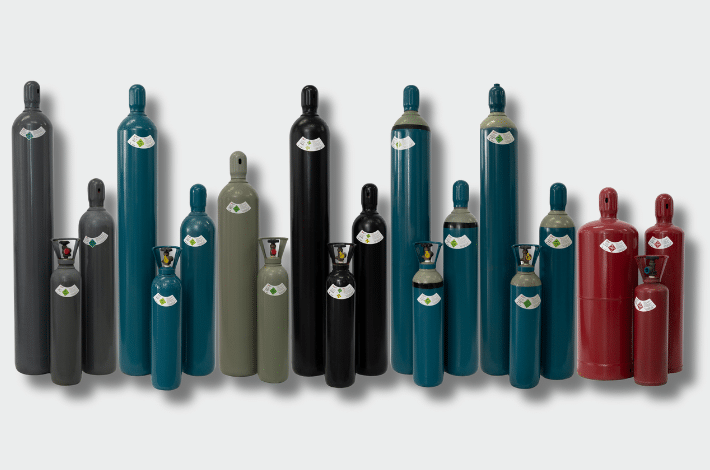
Gas Selection Guide for Different Types of Welding Processes
Choosing the correct shielding gas for welding is critical to achieving strong, clean welds. Different welding processes and materials require specific gases or gas mixtures to optimise performance. In this guide, we’ll explore the types of gases used for various welding processes, focusing on popular methods like MIG (Metal Inert Gas), TIG (Tungsten Inert Gas), and Flux Core Welding.
MIG Welding: Gas Selection for Various Metals
MIG welding is widely used across industries due to its versatility, ease of use, and the ability to weld a variety of metals. Shielding gas plays a vital role in protecting the molten weld pool from atmospheric contamination. Here’s a breakdown of the best gases for different MIG welding applications.
Gas for Mild Steel MIG Welding
For welding mild steel, Carbon Dioxide (CO2) and Argon-CO2 mixtures are the most common choices. A 100% CO2 gas provides deep penetration, making it a cost-effective choice, especially for thicker metals. However, it can produce more spatter, which may require additional cleanup.
For cleaner, smoother welds, a 92% Argon / 5% CO2 / 2% O2 mix is preferred. This combination provides better arc stability, reduced spatter, and improved control over the weld pool. It’s also commonly known as “5/2” and is often considered the best gas for MIG welding mild steel.
Gas for Stainless Steel MIG Welding
For MIG welding stainless steel, pure Argon is often used due to its ability to produce a stable arc and clean welds. Argon effectively minimises oxidation and protects the weld pool from contamination. Although pure Argon is less aggressive in terms of penetration compared to gas mixtures, it is ideal for thinner stainless steel and applications where a clean, precise finish is required.
In cases where more heat and penetration are needed, a mix of 98% Argon / 2% CO2 can be applied. This combination offers better weld penetration while maintaining the corrosion-resistant properties of the stainless steel.
Gas for Aluminium MIG Welding
Aluminium welding is more challenging, requiring a shielding gas that can handle its high thermal conductivity. The most common choice for aluminium MIG welding is 100% Argon. It provides excellent arc stability, prevents oxidation, and allows for a clean weld.
Gas for Car Body MIG Welding
When working on car bodies, where thinner metals are involved, a 92% Argon / 5% CO2 / 2% O2 mix is generally the best gas for MIG welding. This mixture allows for better control over the weld, reduces spatter, and produces a cleaner finish, which is essential when working with delicate automotive panels.
TIG Welding: Shielding Gas Considerations
TIG welding is known for its precision, making it a popular choice for welding thin sections of stainless steel, aluminium, and other non-ferrous metals. The shielding gas in TIG welding is typically 100% Argon, though gas selection may vary depending on the material.
Best Gas for TIG Welding Aluminium
For aluminium TIG welding, pure Argon is widely used. It offers good arc control and stability, ensuring the weld remains clean and oxidation-free. For thicker aluminium, adding a small percentage of Helium (such as an Argon-Helium mix) can provide additional heat and improve penetration.
Best Gas for TIG Welding Mild Steel
For mild steel, 100% Argon is typically sufficient. It provides excellent arc stability and protects the weld pool from atmospheric contamination, leading to a clean, solid weld.
Gas for Stainless Steel TIG Welding
TIG welding stainless steel also benefits from 100% Argon shielding gas, ensuring a smooth arc and preventing oxidation. In some cases, a small addition of Hydrogen (typically 2-5%) to Argon can be used to improve heat input and penetration, though this is more commonly applied to thicker stainless steel.
Flux Core Welding: Gas or No Gas?
Flux core welding comes in two varieties: gas-shielded and self-shielded. In self-shielded flux core welding, the flux within the wire generates the necessary shielding gas, eliminating the need for an external gas supply. This makes it ideal for outdoor welding, where wind could interfere with gas shielding.
However, in gas-shielded flux core welding, an external shielding gas is used. For mild steel, a 80% Argon / 20% CO2 mix is often recommended, similar to MIG welding. This combination provides a stable arc and reduces spatter.
Summary of Gas Choices by Welding Process
| Material | Welding Process | Recommended Gas |
| Mild Steel | MIG | 100% CO2 or 92% Argon / 5% CO2 / 2% O2 |
| Stainless Steel | MIG | 100% Argon or 98% Argon / 2% CO2 |
| Aluminium | MIG | 100% Argon |
| Car Bodies (Mild Steel) | MIG | 92% Argon / 5% CO2 / 2% O2 |
| Mild Steel | TIG | 100% Argon |
| Stainless Steel | TIG | 100% Argon |
| Aluminium | TIG | 100% Argon |
| Mild Steel | Flux Core | 80% Argon / 20% CO2 (gas-shielded) or no gas (self-shielded) |
Choosing the Right Welding Gas
Selecting the right shielding gas is essential to achieving the desired weld quality. Whether you’re working with mild steel, stainless steel, or aluminium, each welding process demands a specific gas or gas mixture for optimal performance.
For MIG welding, gas choices like Argon-CO2 mixes provide versatility, while pure Argon is favoured for precision TIG welding. Be sure to consider the material, process, and project conditions when making your choice, ensuring clean, strong, and durable welds.
This guide should assist you in choosing the best gas for welding, whether you’re working on mild steel, stainless steel, or aluminium, across various processes like MIG, TIG, and Flux Core welding.