
Oxygen Cutting Explained: Equipment, Process and Oxygen Lance Basics
Oxygen does the real work in flame cutting. The fuel gas only heats the steel to the point where a jet of pure oxygen can burn straight through it, which is why the family of processes is known as oxygen or oxy-fuel cutting. Understanding the role of that oxygen stream explains why these methods cut steel so quickly, why they do not work on every metal, and how the same principle scales up to the oxygen lance, a tool that cuts through steel and reinforced concrete far thicker than any hand torch can manage. This guide covers the process, the equipment and the basics of lance cutting for Australian industry.
What is oxygen cutting?
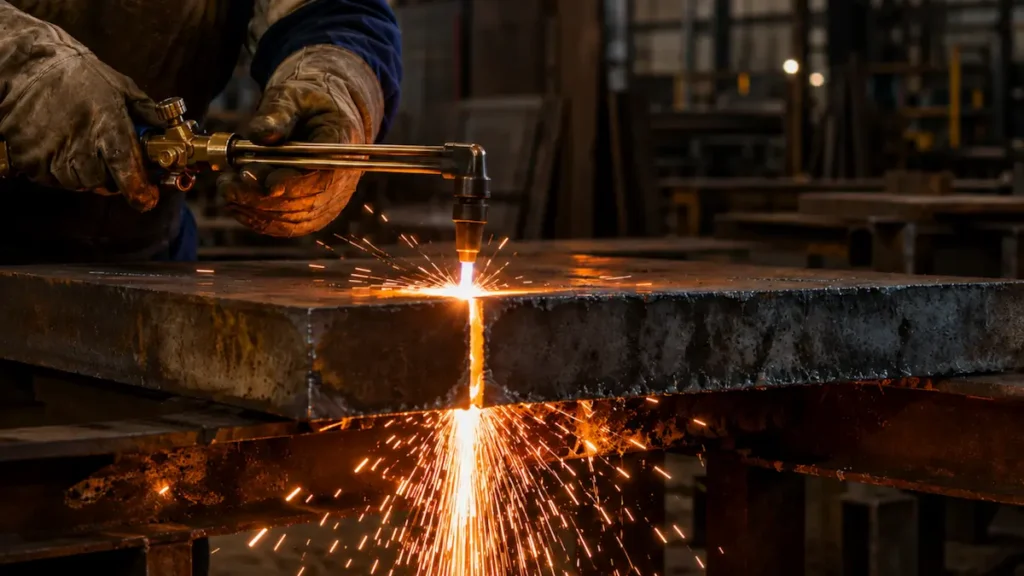
Oxygen cutting is a thermal process that severs steel by burning it in a stream of pure oxygen rather than melting it. A preheat flame first raises a small area of the steel to its ignition temperature, around 900 degrees Celsius. A separate jet of high-purity oxygen is then directed at that hot spot. The oxygen reacts with the heated steel in a rapid oxidation reaction, and the force of the jet blows the resulting molten oxide out of the cut, leaving a clean channel known as the kerf.
The reaction itself releases heat, which helps preheat the steel just ahead of the cut and keeps the process moving. Because the cut depends on the metal oxidising readily, oxygen cutting works on carbon and low-alloy steels but not on metals that resist oxidation, such as stainless steel, aluminium and cast iron.
How oxy-fuel cutting uses oxygen
In a standard hand-torch setup, the most common fuel gas paired with oxygen is acetylene, because its flame is the hottest and most focused and preheats steel fastest. The torch mixes oxygen and fuel for the preheat flames, and a separate lever or trigger releases the high-pressure cutting oxygen down the centre of the nozzle once the steel is hot enough.
Two oxygen supplies are effectively in play: the small amount blended into the preheat flame, and the much larger volume of cutting oxygen that actually severs the metal. The cutting oxygen is consumed far faster, and its pressure and purity largely determine cut speed and edge quality. For the full torch setup, pressures and technique, see our guide to oxy-fuel cutting and brazing.
Equipment for oxygen cutting
A hand-torch oxygen cutting outfit is built around the same core kit as a gas welding set:
- An oxygen cylinder and a fuel-gas cylinder, most often acetylene.
- A two-stage oxygen regulator and a fuel-gas regulator.
- Flashback arrestors fitted at both the regulator and torch ends of both lines.
- Colour-coded twin hose to AS 1335, green for oxygen and red for acetylene.
- A cutting torch or a cutting attachment on a torch handle, fitted with a cutting nozzle sized to the steel thickness.
- A flint striker, tinted eye protection, leather gloves and flame-resistant clothing.
The cutting nozzle is the part that sets capacity: a larger central oxygen orifice delivers more cutting oxygen for thicker plate. As steel gets thicker, the answer is a bigger nozzle and higher oxygen pressure rather than simply turning the gas up on a small one.
What is an oxygen lance?
When steel is too thick for a normal cutting torch, or when there is reinforced concrete to get through, the tool for the job is the oxygen lance, also called a thermic lance, thermal lance or burning bar. It is a long steel tube, often packed with steel or a mix of steel and other metal rods, fed with a continuous supply of high-pressure oxygen.
The lance is consumed as it works. Rather than directing a flame at the workpiece, the lance itself burns, and the operator feeds it forward into the material. This makes it suited to heavy demolition and salvage work where ordinary cutting equipment cannot reach the thickness involved.
How an oxygen lance works
The tip of the lance is first heated to a bright red, usually with an oxy-acetylene torch. Oxygen is then turned on and flows through the tube. The hot steel of the lance ignites in the oxygen and burns in a fierce, self-sustaining oxidation reaction that produces an extremely high temperature at the tip, well above what a normal flame reaches.
Pressed against steel, cast iron or reinforced concrete, that intensely hot, oxygen-fed tip melts and oxidises the material, and the oxygen flow blasts the molten product away. The lance burns down as it goes and is fed forward by the operator. It can work through sections measured in many hundreds of millimetres, which is why it is used in demolition, scrap processing, foundry work and heavy fabrication where speed and reach matter more than a fine finish.
Safety when cutting with oxygen
Oxygen cutting and lance work throw intense heat, sparks, molten metal and fume, and the oxygen-rich conditions add their own hazards.
- Keep oil and grease away from all oxygen fittings. Oxygen reacts violently with hydrocarbons, and a greasy regulator or thread is a serious fire risk.
- Fit flashback arrestors at both ends of both lines, as required under AS 4603, on any oxy-fuel torch.
- Clear flammable material from the spark path and well beyond it, work in good ventilation, and keep a suitable extinguisher to hand.
- Lance work in particular produces extreme heat, heavy slag and a shower of sparks, and demands full protective equipment, a clear exclusion zone and a careful check of what lies behind and below the cut.
- Wear suitably tinted eye protection, leather gloves and flame-resistant clothing for any cutting work.
Frequently asked questions
What is the difference between oxygen cutting and oxy-acetylene cutting?
Oxygen cutting is the general term for severing steel with a jet of pure oxygen after preheating it. Oxy-acetylene cutting is the most common form of it, using acetylene as the preheat fuel. Other fuel gases can be used for the preheat, but the cutting itself is always done by oxygen.
Why does oxygen cutting only work on steel?
The process relies on the metal burning in oxygen. Carbon and low-alloy steels oxidise readily at the preheat temperature, so they cut cleanly. Stainless steel, aluminium and cast iron resist that reaction, so a standard oxygen cut does not work on them.
How thick can an oxygen lance cut?
An oxygen lance cuts far beyond the range of a hand torch, working through steel and reinforced concrete many hundreds of millimetres thick. It is chosen specifically for demolition and salvage tasks where the material is too thick or too awkward for conventional cutting.
Oxygen supply from Pacific Gas
Pacific Gas supplies the high-purity industrial oxygen that oxygen cutting and lance work depend on, along with the acetylene used for the preheat flame, in cylinders through a network of local distributors across Australia. Cylinders are available on rental or customer-owned terms and swapped empty-for-full like a BBQ gas bottle, so a spent cylinder is exchanged for a full one at a participating location. For the matched fuel side and flame settings, see our oxy-acetylene welding guide. To set up reliable oxygen supply for your workshop or worksite, find a local distributor or contact Pacific Gas.


