
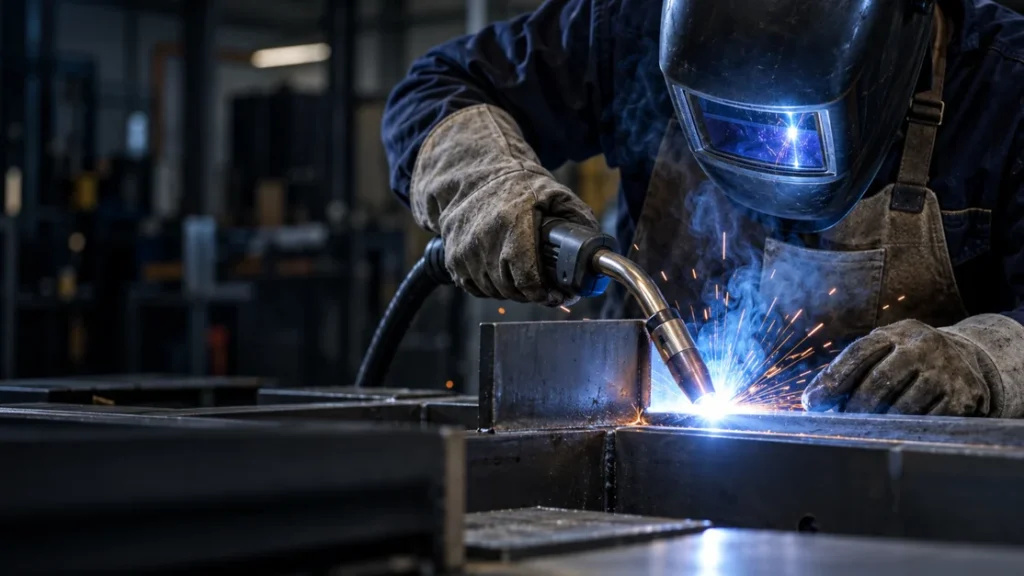
MIG Welding Gas: Choosing the Right Gas and Mix
MIG welding lives or dies on its shielding gas. The wire, the machine settings and the operator all matter, but if the gas is wrong for the metal, the result is porosity, spatter and weak welds that no amount of technique can fix. This guide covers the gases and mixes used for MIG welding in Australian workshops: what each one does, which to run for mild steel, stainless steel and aluminium, what flow rate to set, and how to work out the right cylinder size for the amount of welding being done.
What MIG Welding Gas Does
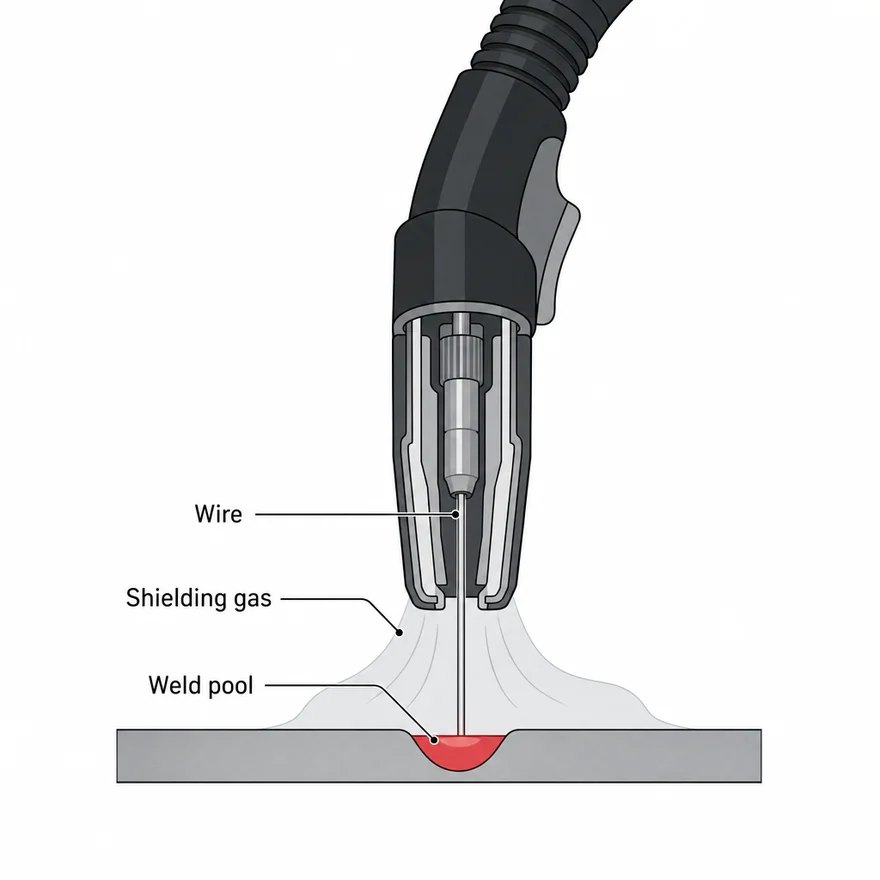
MIG welding feeds a consumable wire electrode through the torch into the weld pool. The moment that metal melts, it becomes reactive. Oxygen and nitrogen from the surrounding air will combine with the molten pool and cause porosity, brittleness and a weak, contaminated weld.
The shielding gas flows out of the torch nozzle and forms a protective envelope over the arc and the pool, keeping air away until the metal solidifies. The gas also shapes the arc itself. Different gases transfer heat differently, which changes penetration, spatter levels, bead profile and how the finished weld looks.
That is why gas selection is not one-size-fits-all. The right choice depends on the metal being welded, its thickness, and the balance a welder wants between penetration, spatter and finish quality. For a broader look across TIG, flux core and oxy processes, start with the guide to choosing the right welding gas; this page focuses on MIG.
The Main MIG Welding Gases and Mixes
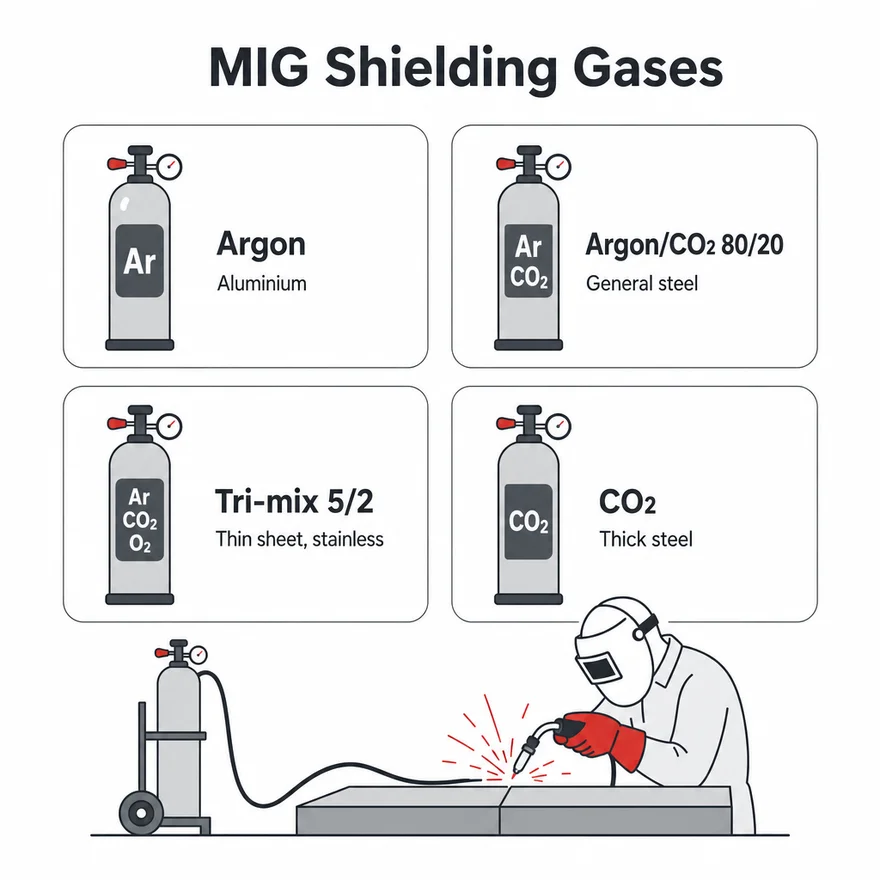
Australian workshops run MIG on a short list of gases, used straight or pre-blended.
Argon
Argon is fully inert. It does not react with molten metal at any temperature, which makes it the base of nearly every MIG shielding mix and the straight gas of choice for aluminium and other non-ferrous metals. On its own it gives a smooth, stable arc with low spatter, but on steel it lacks the penetration that a touch of CO2 or oxygen provides.
Argon/CO2 Mixes
For steel, a blend of argon with CO2 gives the best of both: argon supplies arc stability and a clean finish, CO2 adds heat and penetration. Pacshield 80/20 (80% argon, 20% CO2) is the standard all-round mix for general steel fabrication. It handles a wide range of thicknesses and wire sizes, which is why it is the default bottle in most workshops.
Pacshield 5/2 (92% argon, 5% CO2, 2% oxygen) is a finer blend for work where finish matters. The small oxygen addition wets out the weld pool for a flatter, cleaner bead with minimal spatter, which suits thinner sheet and automotive panels.
Carbon Dioxide
Straight CO2 can also be used on mild steel. It is economical and gives deep penetration on thicker sections, but the arc is harsher, spatter is heavier and the finished bead usually needs more cleanup. It suits heavy structural work where penetration outranks appearance.
Choosing MIG Gas by Metal
Mild Steel
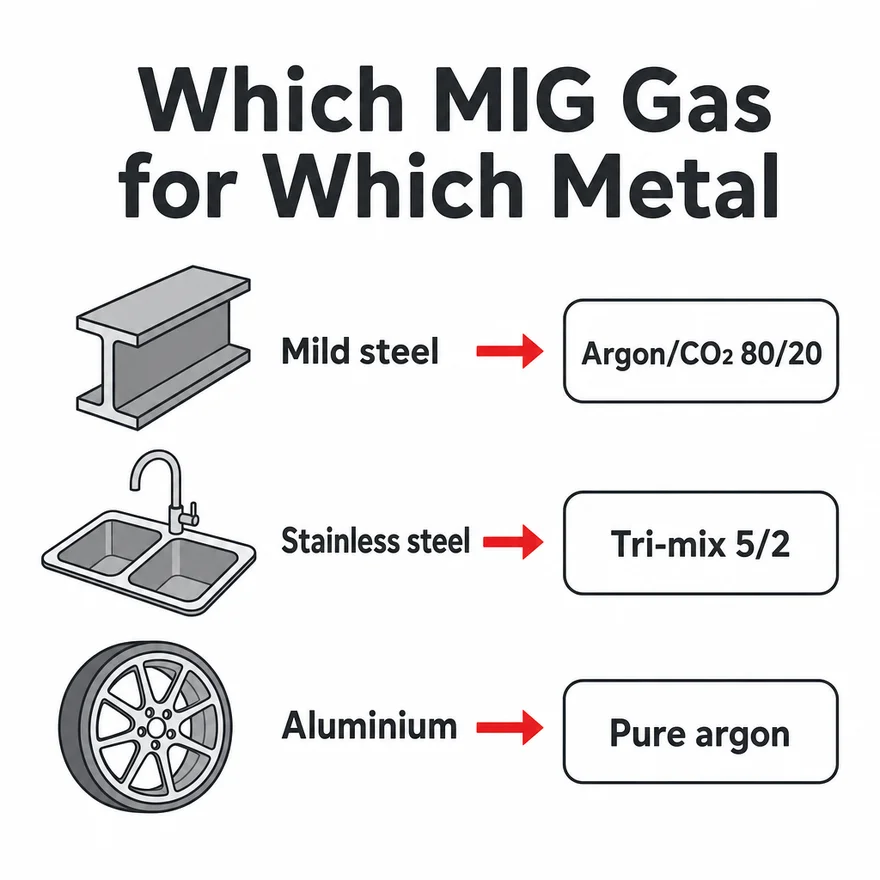
Pacshield 80/20 is the go-to for mild steel MIG welding. It runs cleanly across general fabrication, from brackets and frames to trailers and structural repairs. For thicker sections where maximum penetration matters more than tidiness, straight CO2 is a workable, lower-cost option. For thin sheet where burn-through and cleanup are the concern, step across to Pacshield 5/2 for a softer arc and a flatter bead.
Stainless Steel
Stainless steel is TIG welded on pure argon, not MIG welded on a mix. Pacific Gas’s product guidance for stainless is pure argon; the Pacshield mixes are for general steel MIG welding. High-CO2 mixes are kept away from stainless because excess carbon pickup reduces its corrosion resistance.
Aluminium
Aluminium MIG welding uses 100% argon, no mix. Aluminium conducts heat quickly and forms an oxide layer the moment it is exposed to air, so it needs a fully inert shield. Argon delivers a stable arc and clean, oxide-free welds. There is more on gas selection and technique in the guide to argon for aluminium welding.
Car Bodies and Thin Sheet
Automotive panel work combines thin material with a need for a clean finish. Pacshield 5/2 is the best MIG gas for car body repairs: the softer arc gives better control on delicate panels, reduces spatter and leaves less grinding before paint.
Flow Rates and Setup
Most MIG work runs at a gas flow of roughly 12 to 18 litres per minute at the nozzle. Too little flow lets air reach the pool and causes porosity; too much creates turbulence that drags air in and wastes gas just as fast.
A few practical points help the gas do its job. Check the regulator and hose connections for leaks with soapy water, because a slow leak empties a cylinder surprisingly quickly. Keep the nozzle clean of spatter so the gas flows in an even column. And shield the work area from wind: a breeze of a few kilometres per hour is enough to strip the gas envelope off the weld, which is why MIG welding outdoors needs screens or a sheltered bay.
Cylinder Sizes and How Long a Bottle Lasts
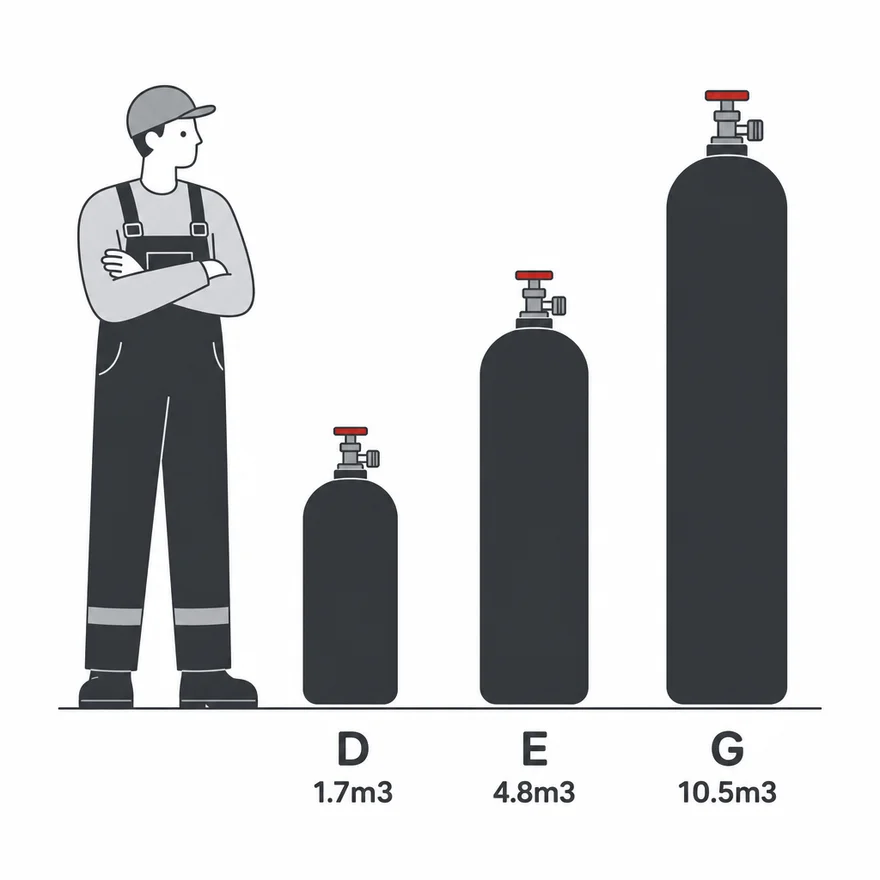
Pacific Gas supplies MIG welding gas in three cylinder sizes: D, E and G. For argon and argon-based mixes, a D cylinder holds 1.7 cubic metres of gas, an E holds 4.8 cubic metres and a G holds 10.5 cubic metres.
Run time is straightforward to estimate: cylinder contents divided by flow rate. An E-size cylinder holding 4.8 cubic metres (4,800 litres) at a typical 15 litres per minute gives around 320 minutes, a bit over five hours of actual arc-on time. A D size suits occasional repair work, an E size suits regular workshop use, and a G size suits fabrication shops welding daily. The guide to choosing the right gas cylinder size covers the trade-offs in more detail.
MIG Welding Gas FAQ
What gas do I need for MIG welding mild steel?
An 80/20 argon/CO2 mix such as Pacshield 80/20 is the standard choice for mild steel. It balances penetration, arc stability and spatter control across general fabrication. Straight CO2 works on thick sections where deep penetration matters more than finish.
Can I MIG weld with 100% CO2?
Yes, on mild steel. CO2 is economical and penetrates deeply, but expect a harsher arc, more spatter and more cleanup than an argon/CO2 mix. It is not suitable for stainless steel or aluminium.
Can I use the same gas for MIG and TIG welding?
Only if the gas is pure argon. Argon works for TIG on most metals and for MIG on aluminium. Argon/CO2 mixes are MIG-only: CO2 breaks down in the TIG arc and will contaminate the tungsten electrode.
What happens if I MIG weld without gas?
With standard solid MIG wire, the weld will be porous, brittle and full of holes as air reaches the molten pool. The exception is self-shielded flux core wire, which generates its own shielding and needs no bottle.
How do I know when a MIG gas cylinder is nearly empty?
Watch the contents gauge on the regulator. Pressure falls steadily as gas is used, and once it drops toward the bottom of the scale it is time to organise a swap. Keeping a spare cylinder on hand avoids stopping mid-job.
MIG Welding Gas Supply from Pacific Gas
Pacific Gas supplies argon, CO2 and the Pacshield 80/20 and Pacshield 5/2 argon mixes in D, E and G cylinders through local distributors across Australia. Supply works on a simple cylinder exchange: an empty bottle is swapped for a full one, the same way a BBQ gas bottle is swapped, on customer-owned cylinders with no rental contract. To get set up with the right MIG gas, find a distributor nearby or contact Pacific Gas for advice on the best gas and cylinder size for the job.


