
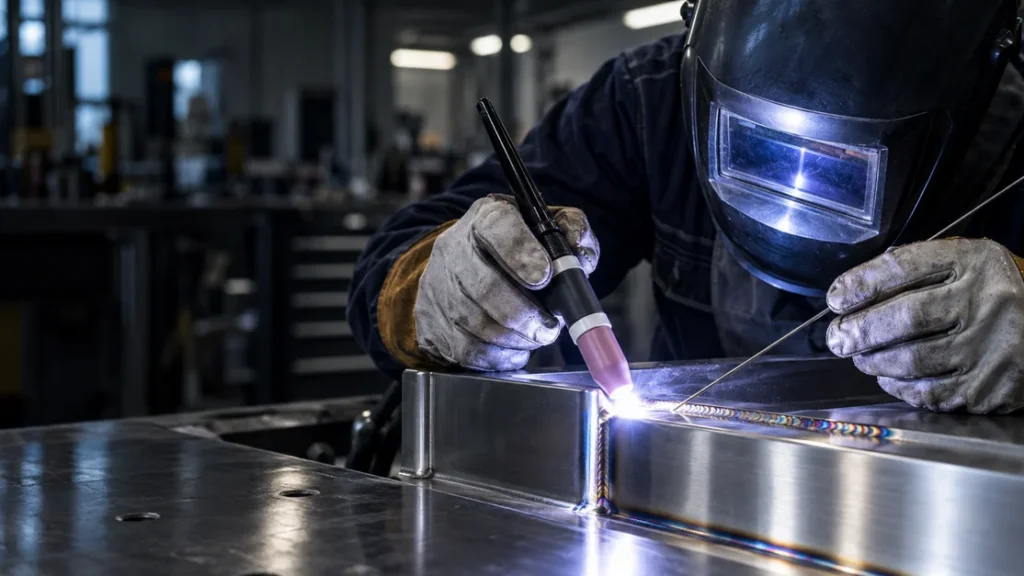
TIG Welding Gas: Choosing the Right Shielding Gas
TIG welding has the simplest gas answer in the workshop and the least room for error. The answer is pure argon for almost every job, but running it wrong, wrong flow, wrong cup, no back purge on stainless, is what separates a clean silver weld from a grey, contaminated one. This guide covers why argon owns TIG, how the gas behaves at the torch, what changes across steel, stainless and aluminium, and how to size and set up the cylinder behind the machine.
Why TIG Runs on Pure Argon
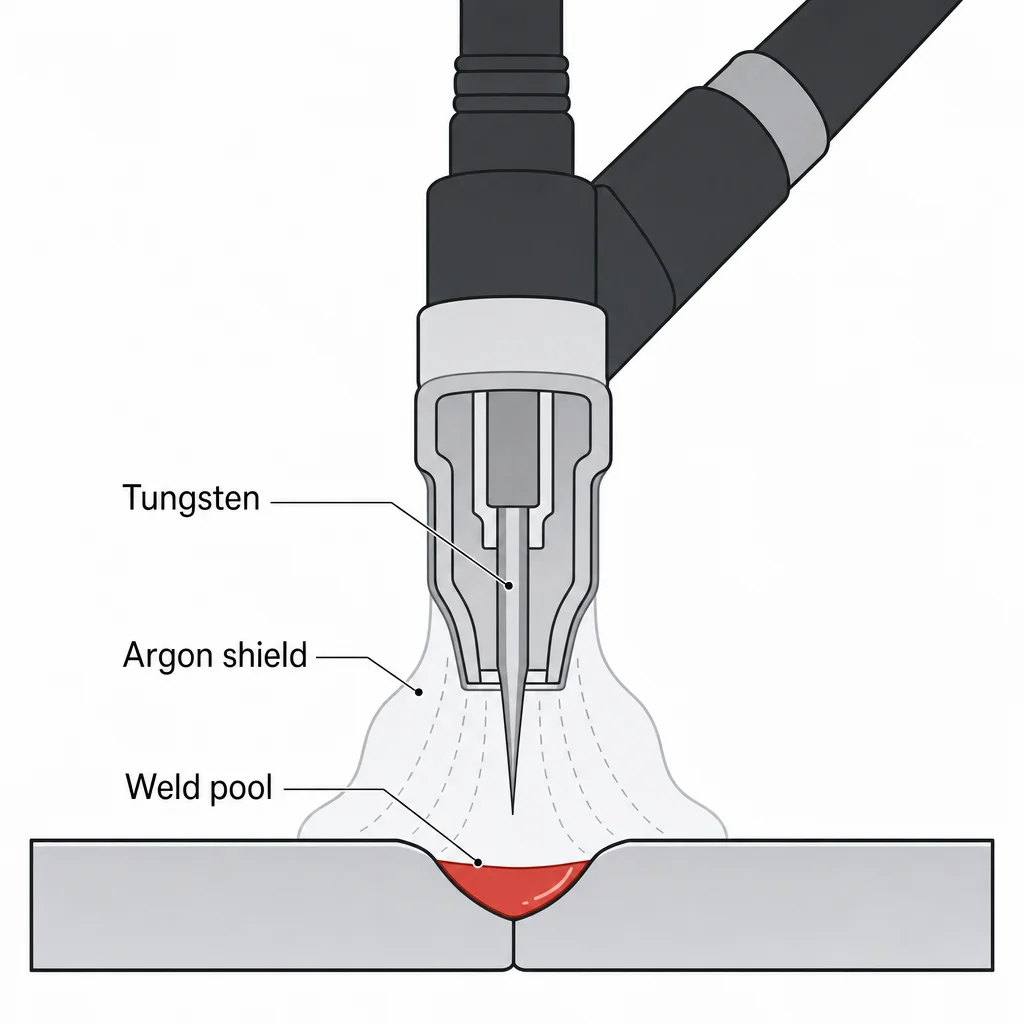
TIG welding strikes an arc between a non-consumable tungsten electrode and the work, with filler rod added by hand. That tungsten electrode is the reason the gas rules are strict: anything reactive in the shielding gas attacks the tungsten tip and contaminates the weld pool at the same time.
Argon is fully inert. It does not react with the tungsten, the arc or the molten metal at any temperature. It is also denser than air, so it settles over the weld pool and holds a stable protective cover at modest flow rates, and it ionises easily, which gives TIG its soft, controllable arc start and stable arc at low amps.
This is why the MIG mixes on the shelf stay on the MIG side of the workshop. Argon/CO2 blends such as the Pacshield mixes are made for MIG on steel; the CO2 content that helps a MIG arc will burn the tungsten electrode in seconds on TIG. If the bottle is not marked pure argon, it is not a TIG bottle.
TIG Gas by Metal
Mild and Carbon Steel
Pure argon, no substitutions. Steel TIG work runs cleanly on argon at moderate flow, and the arc stays stable from thin sheet up to heavy sections. There is no benefit in blends for steel TIG, and reactive additions are actively harmful.
Stainless Steel
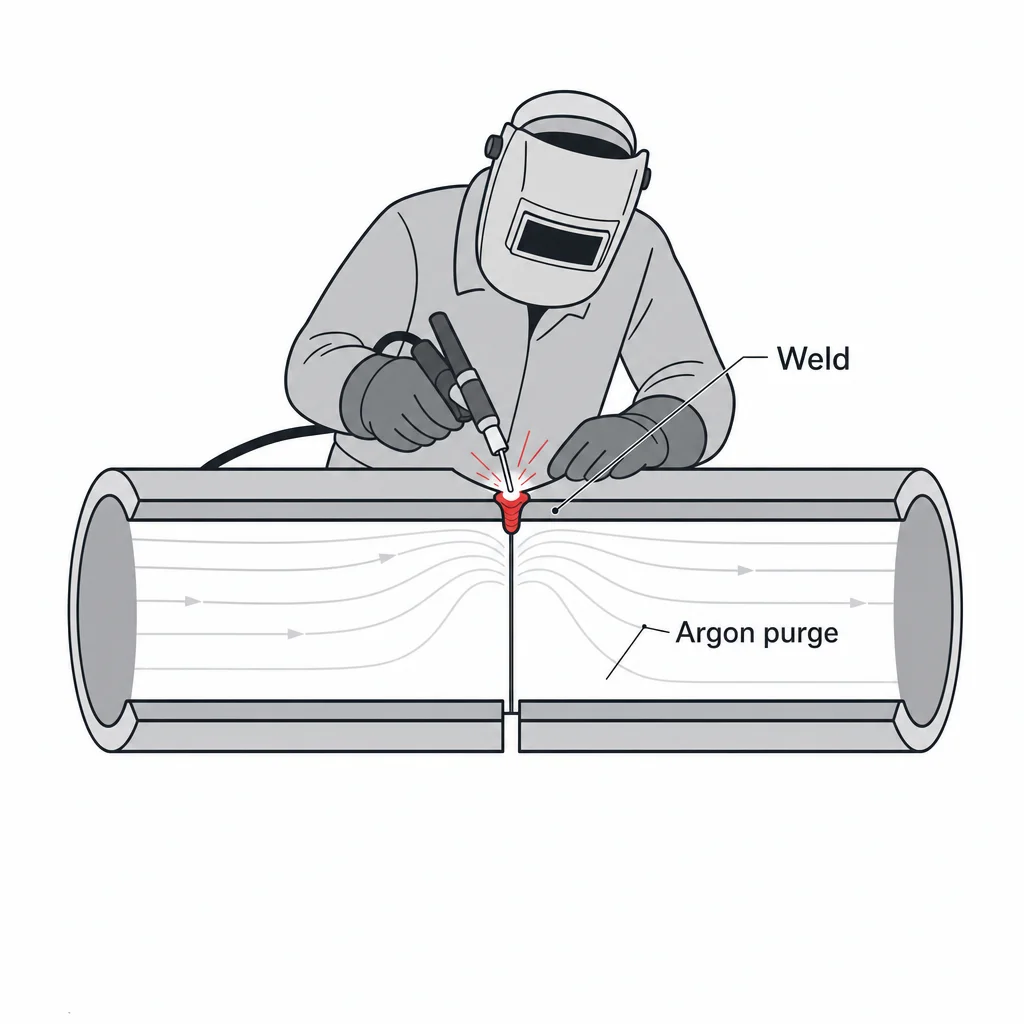
The torch side is the same pure argon. Stainless adds a second gas job: protecting the underside of the weld. At welding temperature, the back face of a stainless joint oxidises if left in air, a defect welders call sugaring, which destroys corrosion resistance right where the weld needs it. The fix is back purging: flooding the reverse side of the joint with argon before and during the weld. Pipework, food-grade and sanitary stainless jobs treat the purge as non-negotiable.
Aluminium
Pure argon again, paired with AC on the machine. Aluminium sheds heat quickly and carries a surface oxide layer that melts far above the parent metal, so the machine settings do the hard work while argon provides the cover. Some references suggest helium additions for very thick aluminium; in Australian practice, thick-section work is usually handled with preheat and technique on straight argon.
Flow Rates, Cups and Common Gas Mistakes
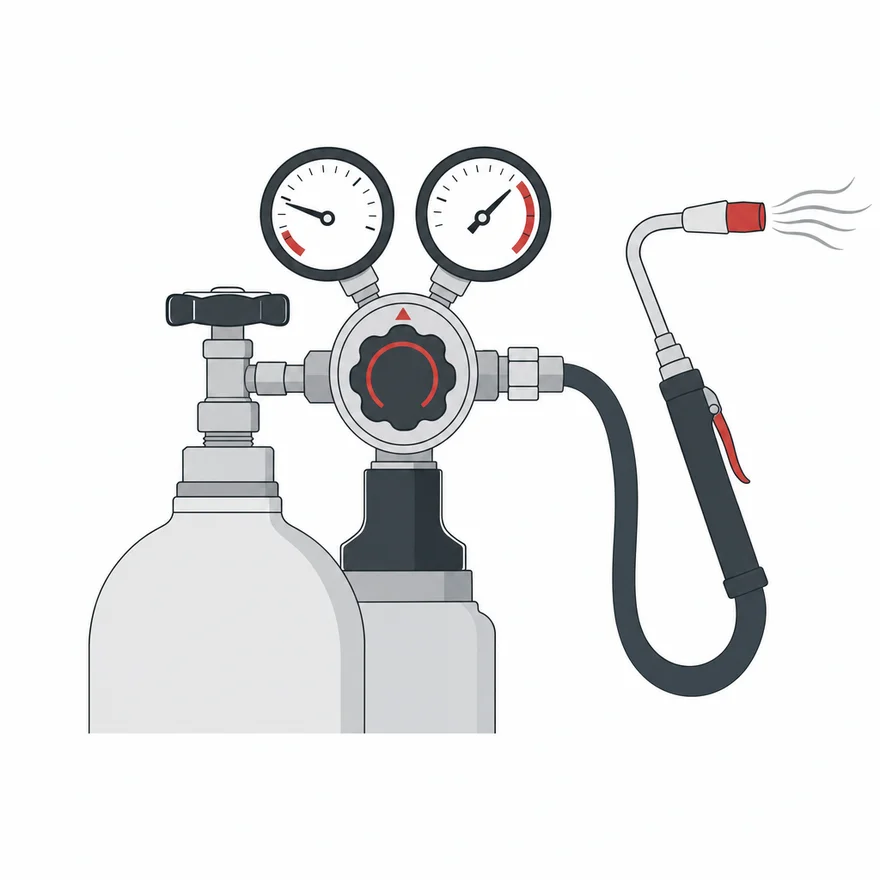
TIG runs lower flow than MIG. Most work sits between 6 and 12 litres per minute at the torch, with the higher end for larger cups and outdoor-adjacent conditions. More is not better: past the cup’s design flow, the gas column goes turbulent and drags air into the weld zone, causing the exact contamination it is meant to prevent.
The details that matter day to day. Match flow to cup size, roughly the cup number in litres per minute is a workable starting point. Use a gas lens for stainless and anywhere the tungsten needs a long stick-out; it smooths the flow and widens the coverage. Set pre-flow and post-flow so the tungsten and the pool are covered before the arc starts and while the metal cools, around one second of post-flow per 10 amps is the common rule. Check connections for leaks, a leaking line does not just waste gas, it pulls air in and porosity shows up with no obvious cause.
Cylinder Sizes for TIG Work
Pacific Gas supplies pure argon in three cylinder sizes: D at 1.7 cubic metres, E at 4.8 cubic metres and G at 10.5 cubic metres, filled to 200 bar. At a typical TIG flow of 8 litres per minute, an E-size bottle gives roughly ten hours of arc time and a G more than twenty, which in intermittent workshop use stretches across weeks or months. A mobile fitter carrying the bottle in a ute is best on a D or E; a fabrication bay TIG welding daily belongs on a G. The full run-time maths and per-gas contents are covered in the gas cylinder size guide.
TIG Welding Gas FAQ
What gas do I need for TIG welding?
Pure argon. It covers steel, stainless steel and aluminium, protects the tungsten electrode and gives TIG its stable, controllable arc. Reactive mixes made for MIG are not usable on TIG.
Can I use a MIG argon/CO2 mix for TIG?
No. The CO2 in MIG blends oxidises the tungsten electrode almost immediately, contaminating the electrode and the weld. TIG needs pure argon; keep a separate bottle for each process.
What flow rate should TIG argon run at?
Between 6 and 12 litres per minute for most work, matched to cup size. Too little exposes the pool to air; too much causes turbulence that pulls air in. Add post-flow of roughly one second per 10 amps to protect the cooling weld.
Do I need to back purge stainless steel?
For full-penetration joints, pipework and anything sanitary or corrosion-critical, yes. Back purging floods the underside of the joint with argon so it cannot oxidise. Cosmetic surface work on thicker sections can sometimes skip it, but purge whenever the root is exposed.
Is TIG argon different from MIG argon?
No. Pure argon is the same gas in either process. The same D, E or G argon cylinder runs TIG on any metal and MIG on aluminium.
TIG Welding Gas from Pacific Gas
Pacific Gas supplies pure argon in D, E and G cylinders through local distributors across Australia, on customer-owned cylinder exchange with no rental contract, the empty bottle swaps for a full one at the counter. The same argon covers TIG across every metal, MIG on aluminium and purging duties on stainless. For supply near a specific site or advice on sizing a bottle to a workload, contact Pacific Gas.


